

In This Article
- Introduction
- Understanding Fertility Treatment
- What Is IUI Fertility Treatment?
- What Is IVF Fertility Treatment?
- Difference Between IUI vs IVF
- Fertility Supplements To Support IUI or IVF Treatments
- Conclusion
- FAQs
Introduction
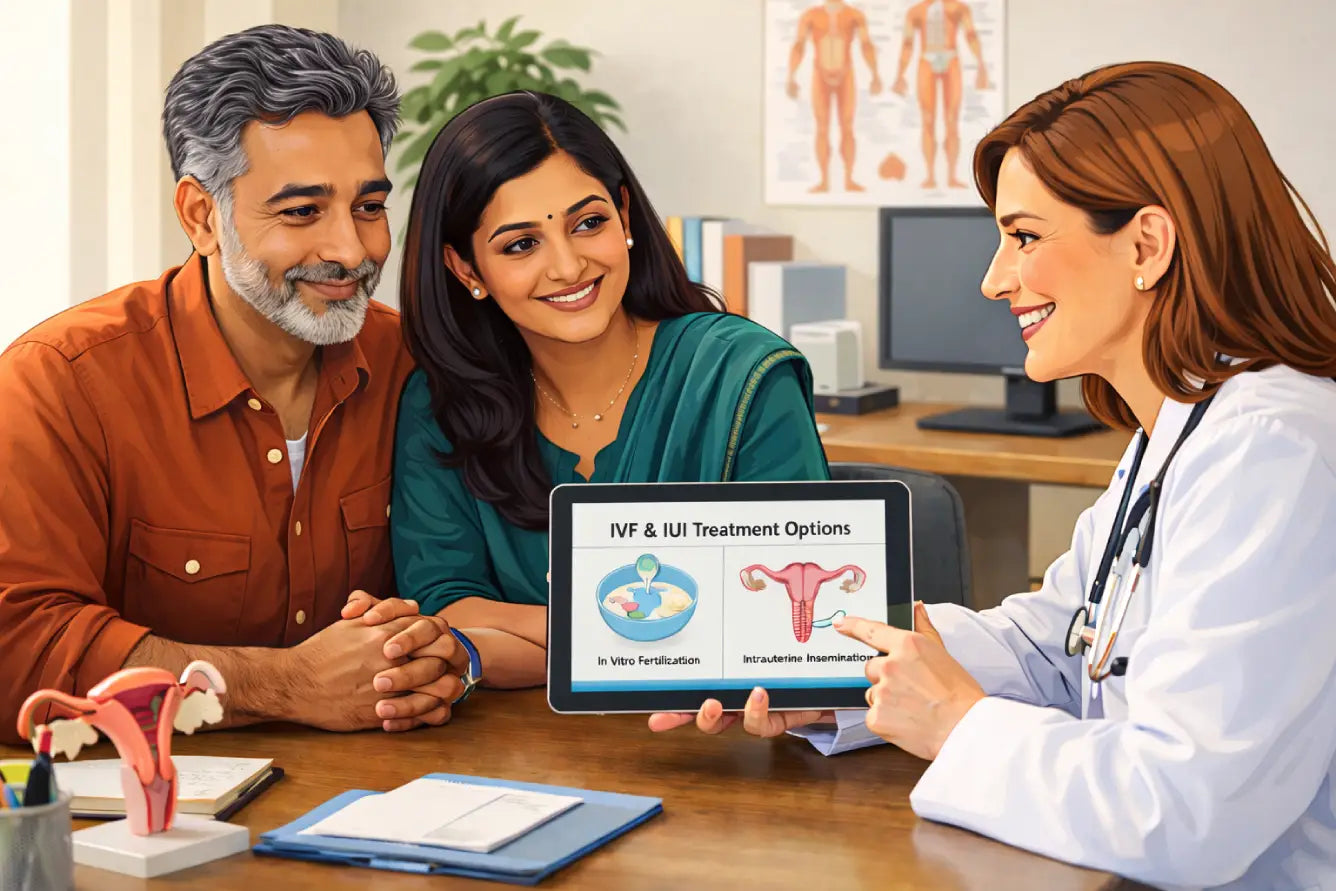
Starting a fertility treatment journey can feel overwhelming. Your doctor may suggest assisted reproductive techniques, like IVF or IUI, if you have been trying to conceive for a long time. With multiple clinics offering advanced reproductive care, choosing the right fertility treatment can feel confusing.
This can raise certain concerns like, what is the difference between IVF and IUI? Or which fertility treatment is right for you? The decision between IUI fertility treatment and IVF fertility treatment depends on various factors.
Understanding Fertility Treatment
A fertility treatment is a medical approach used to help couples conceive when natural conception is difficult. In India, infertility affects nearly 10 - 25% of couples. Infertility is becoming common due to factors such as delayed marriage, work stress, PCOS, thyroid disorders, endometriosis, low sperm count, and lifestyle habits.
Before suggesting any treatment, doctors perform basic fertility tests for both partners. This includes:
- Blood tests to check hormone levels (AMH, FSH, LH, TSH, prolactin)
- Ultrasound scans to evaluate the uterus and ovaries
- HSG test to check if fallopian tubes are open
- Semen analysis to assess sperm count and motility
Your doctor will suggest treatment options, based on your results. The most common fertility treatment options are:
- IUI (Intrauterine Insemination)
- IVF (In Vitro Fertilization)
What Is IUI Fertility Treatment?
IUI (Intrauterine Insemination) fertility treatment is a simple and less invasive procedure. In this method, the partner's sperm is placed directly inside the woman’s uterus during ovulation. The procedure takes only a few minutes and usually does not require anaesthesia.
IUI is recommended in cases of:
- Mild male factor infertility (low sperm count or motility)
- Ovulation disorders
- Cervical mucus problems
- Unexplained infertility
- Couples who want a less aggressive first step
Fertility Treatment Steps in IUI
- Ovulation Monitoring – Your doctor tracks ovulation using ultrasound or blood tests.
- Fertility Treatment Medications – Mild hormone tablets or injections are prescribed to stimulate egg release.
- Sperm Preparation (Sperm Wash) – The healthiest sperm are separated in a lab.
- Insemination Procedure – The processed sperm is inserted into the uterus directly using a thin catheter.
-
Pregnancy Test – Done about 14 days to check for pregnancy.
What Is IVF Fertility Treatment?
IVF (In Vitro Fertilization) fertility treatment is a more advanced procedure where fertilisation happens outside the body in a laboratory. In IVF, eggs are retrieved from the ovaries, fertilised with sperm in a lab, and the resulting embryo is transferred into the uterus.
IVF is recommended in cases of:
- Women with damaged fallopian tubes
- Severe male factor infertility
- Women above 35 with low egg reserve
- Moderate to severe endometriosis
- Couples with repeated failed IUI cycles
- Women with PCOS who did not respond to other treatments
- Individuals using donor eggs or sperm
Fertility Treatment Steps in IVF
- Ovarian Stimulation – Stronger fertility treatment medications like hormone injections are given to stimulate release of multiple eggs.
- Monitoring – Regular ultrasounds and blood tests track egg development.
- Egg Retrieval – A minor procedure under anaesthesia is done to collect the eggs from the ovaries.
- Fertilisation in Lab – Healthy eggs and sperm are combined to create embryos.
- Embryo Transfer – A healthy embryo is placed into the uterus.
- Pregnancy Test – Conducted after 14 days to check for pregnancy.

Difference Between IUI vs IVF
|
IUI |
IVF |
|
|
Type of Fertility Treatment |
Basic assisted fertility treatment |
Advanced assisted reproductive technology |
|
Where Fertilisation Happens |
Inside the woman’s body (natural conception process) |
Outside the body in a laboratory |
|
Fertility Treatment Medications |
Mild hormone tablets or low-dose injections |
Strong hormonal injections for ovarian stimulation |
|
Egg Retrieval Procedure |
Not required |
Required (minor surgical procedure under sedation) |
|
Success Rate Per Cycle |
10–20% (depends on age & condition) |
40–60% in women under 35 (varies by age & diagnosis) |
|
Number of Cycles Needed |
Requires multiple cycles |
Fewer cycles due to higher success rate |
|
Cost of Fertility Treatment in India |
More affordable |
Higher cost due to advanced procedures |
|
Advantages |
Less invasive Lower cost Simple treatment process |
Higher success rate Suitable for complex infertility Embryo freezing option |
|
Limitations |
Lower success rate Not suitable for severe infertility |
Expensive physically and emotionally demanding |
Fertility Supplements To Support IUI or IVF Treatments
Nutritional fertility supplements are helpful for couples preparing for IUI or IVF fertility treatment. These are nutrient-rich formulations that support reproductive health, egg and sperm quality, hormonal balance, and preconception nutrition (always consult a doctor before use).
Sperm Quality: Fertility supplements for men with folic acid, zinc, vitamin D, and antioxidants help support sperm health, and DNA protection, during IVF or IUI cycles.

Ovulation support: Preconception Multivitamins with iron and folate are recommended 3 to 6 months before trying to conceive. This helps to optimize nutrient reserves and support healthy pregnancy.

Hormonal Balance: Fertility supplements for women with CoQ10, inositol and resveratrol support regular ovulation and insulin balance. This is helpful for women with irregular cycles, endometriosis or PCOS.
Conclusion
Choosing between IUI fertility treatment and IVF fertility treatment depends on your age, diagnosis, lab results and long-term pregnancy goals. Understanding the difference between IUI and IVF helps you make confident and informed decisions. While IUI is a simpler and more affordable fertility treatment, IVF offers higher success rates for complex infertility cases. The right fertility treatment should be personalised after medical evaluation by a gynecologist.
FAQs
Which fertility treatment has a higher success rate: IUI or IVF?
IVF fertility treatment has a higher success rate than IUI. IUI success rates range from 10–20% per cycle, while IVF success rates can range from 40–60% in women under 35. Age, diagnosis, lab results and overall reproductive health affect outcomes.
Which fertility treatment is better for unexplained infertility?
For mild or short-term unexplained infertility, doctors recommend starting with IUI fertility treatment. If multiple IUI cycles fail or infertility is present for several years, IVF fertility treatment provides better success rates.
Which fertility treatment medications are used in IUI and IVF?
In IUI, mild fertility treatment medications like ovulation induction tablets or low-dose hormone injections are used. In IVF, stronger hormone injections are used to stimulate the development of multiple eggs.
Is IVF more painful than IUI?
IUI is minimally invasive and painless. IVF involves multiple injections and a minor egg retrieval procedure under sedation.
How many fertility treatment cycles are needed?
IUI requires 3 to 4 cycles before success. IVF requires fewer cycles due to higher success rates, but it depends on age and fertility diagnosis.
What is the cost difference between IUI and IVF in India?
IUI is more affordable per cycle, making it a common first-line fertility treatment. IVF costs more due to laboratory procedures, medications, and advanced technology.
How do I decide between IUI and IVF?
Choosing between IUI and IVF depends on age, underlying fertility issues, egg reserve, previous treatment history, and financial considerations. Consulting a gynecologist is essential to determine the most suitable fertility treatment.
References
- https://doi.org/10.1186/s12905-023-02717-1
- https://doi.org/10.1016/j.rbmo.2021.12.015
- doi:10.18502/jri.v23i2.8993


